Last Friday, February 27th, 11am. I just finished 2.5 hours of drawing, the rest of the day was supposed to be “a little vacation” for me, since I planned to meet up with a friend instead of working.
But then turns out the meeting had to be cancelled. I thought that it was unfortunate, and it indeed was, but not for the reason I thought initially.
“Damn… now what am I even supposed to do for the rest of the day” – I thought. I didn’t have any plans so I just cooked dinner, sent some emails, watched YouTube for 2 hours, re-wrote my commission ToS and went to sleep.
The “little vacation” was supposed to end after I met up with my friend, but it didn’t happen, so it bled into the next day, and the next… now I’m writing this on Thursday and I’ve finally mentally put an end to it yesterday after watching YouTube for 5 hours with a little break in-between to play games.
What went wrong
When I just started following the productivity system that I described in This doubled how much I draw it was very simple to follow. Not because the system is easy but because I was very motivated by the novelty of it. Everything felt different, how my day went changed dramatically.
Week 2 felt the same as the end of week 1 though, I didn’t feel any changes or improvements. I was still following the same system but it wasn’t novel anymore. The excitement for novelty was hiding the fact that I haven’t actually seriously committed to it, and now I could see that clearly.
What was bizarre to me though is that my gym habit was insanely consistent. I skipped only 2 days (because I was sick) in the 6 months I’ve been going. I went 4 times per week without exception. Even when we had exams at school, I still somehow found time in the day to get a full workout in. So how is that possible?
The importance of measurement
I’m addicted to seeing progress in numbers. From week 1 I was following a structured program, a 4x Upper Lower split, so every day I knew exactly what to do. On week 3 of going to gym I started tracking every single workout in an app. So every day I saw the exact weight and reps I did last week on the same exercise. Every day was an opportunity to push a little harder and get a new PR. So it wasn’t a question of if I want to go to gym or not, the question was “When do I get to make those numbers go up today?”.
Now let’s compare that to the internet-off system. Every time I did anything I had to ask myself “does this need internet?” and then either plug the Ethernet cable back in or unplug it – that is very lame and gets tedious. Every decision requires willpower and mine was running out quick. There was also no way to clearly see if I’m making progress unless I deliberately looked through the calendar and calculated how much time I spent being productive.
Here’s the difference: Gym: structured program, clear metrics, immediate feedback. Internet-off: constant decisions, no visible progress, willpower depleting.
So it’s clear by now that to make a habit stick, a serious commitment to gathering and tracking data had to be made (at least for me). The honeymoon period of any new habit is so effortless because the novelty of it is what keeps you going. The difference between riding novelty and actually building a habit is having concrete feedback.
How you can generate feedback
I grabbed a sheet of paper, drew a scoreboard and hung it on my wall.
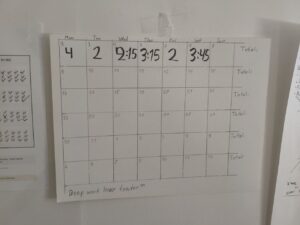
From now on before going to sleep I am writing down how much time I spent on drawing that day. At the end of the week I will add it all up and write the total time. I am not sure if this will work as well as the gym app, but we will see.
You can try it too:
- Take a piece of paper
- Draw a calendar grid
- Every night before bed, write one number: hours you drew today
- At the end of the week, add them up
Now you have one number that tells you how well you’re doing each week.