I recently got an email from a reader that really stuck with me. They’ve been studying fundamentals for years, going to classes and doing the work. But are still terrified of actually drawing what they imagine because it might not match their vision.
My answer was that this fear never really goes away, and that you just learn to manage the speculation. Now I’ve given it more thought and I want to share exactly how I manage it.
I remember when the idea for my Learn to Swim illustration hit me back in January. It was almost my bed time, I was sitting at my desk and listening to “Ænema” by Tool. When I’ve heard Maynard sing “learn to swim” again, it felt different this time, it was more of an emotional gut punch than just a cool line. I didn’t know exactly why at first, but at this time I was also trying to think of what my next art project should be, and this was the perfect lead.
Stress-testing the idea
Immediately, my brain went to the easiest, most literal place. I imagined an epic scene of Venjiro falling from a high bridge into the ocean, mid-battle. It had a movie poster vibe, but didn’t make me feel any emotions.
I knew I had to dig deeper, so I asked myself: What does learning to swim actually look like for me right now? It looks like sitting in my room, surrounded by creative devices like my drawing tablet, my guitar, a midi keyboard. But having to spend most of my day at college. Having to “swim” through that while keeping the vision of my dream life alive. In the final piece, Venjiro is on the floor with his rifle, but the mirror shows that he could’ve been a guitarist instead. This is exactly the friction that was missing.
That’s where the fear of “it won’t match my imagination” comes in. You have this great idea, and are speculating about how the actual result will look. If you start sketching right now, you’ll get lost quickly, and most likely the result will be underwhelming. To get through this properly, you have to translate your vague imagination into actual reference images.
If the idea gets more exciting the more references you find (the specific environment the character is in, their outfit, what are the light sources, what is the character holding) – you know it’s great. Keep going with it.
If the more you flesh out the reference board, the more boring it looks – you know you need to adjust the concept.
Imagination has to be grounded in visuals. References are there to prove that your vision can actually exist in the physical world. That’s all the confidence you need to start. If there’s already a picture that’s close to what you’re imagining, then you can do it too. At this point it’s just a question of how much time you’re willing to invest to make it look good.
Here’s what the board looked like for my illustration:
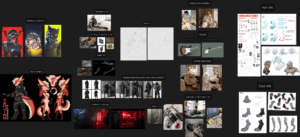
When I started, I thought it wouldn’t take more than 30 hours. It took 42. But because I had a solid board, I didn’t feel lost throughout the project. I gave myself the permission to spend the time the work needed, and that was liberating.
The practical framework
Here’s exactly what I recommend doing for every big project:
- Get PureRef – it’s free and pretty much perfect.
- Describe your idea in a text document. If you find yourself getting bored while writing it, the idea isn’t strong enough yet.
- Find specific images for every element you want to include in the illustration. I use Pinterest, Google and Yandex images for that.
- When all that is done, time to create a simple sketch to establish the composition. Think about big shapes here, how they interact and guide the viewer.
- If it doesn’t excite you at this point, keep digging for references and refining the idea. Don’t commit to something that doesn’t deserve your best effort.
Whenever I’m afraid that I can’t actually create what I’m imagining, this is the exact process I use to surround myself with proof that it’s possible.